

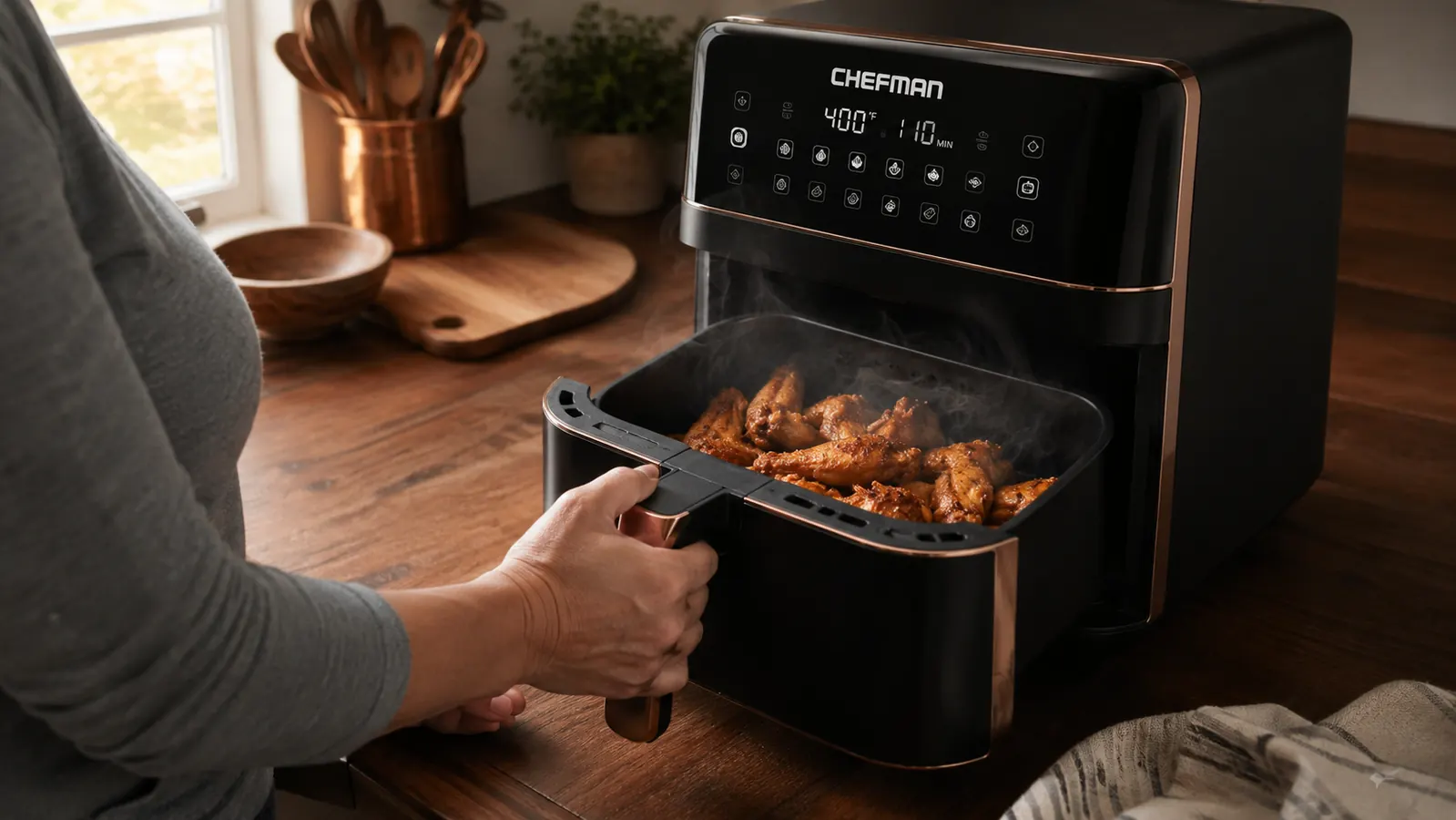
Every air fryer review I read before buying the Chefman Multifunctional Digital Air Fryer showed the same golden, crispy hero shot: fries fanned out on a plate, steam curling up, natural light streaming in from somewhere just out of frame. None of those photos showed me the plastic smell that filled my kitchen for the first two uses, or the six inches of clearance the unit needs above it that my cabinet doesn't actually have. I bought the Chefman in January to replace a basket fryer that had started smoking every time I ran it, and eight weeks in, I've learned more about what this appliance actually is than any five-star review told me going in.
This isn't the review that tells you the Chefman is perfect, because it isn't, and if I'm honest, some of what happened in the first two weeks nearly had me boxing it back up for a return. It's also not the review that tells you to skip it entirely, because eight weeks later it's still the appliance I reach for four nights out of seven. What follows is the stuff nobody mentions in the glossy version: the smell, the cord, the presets you'll never use, the fork that bent on my first rotisserie attempt, and the noise level once you push the Chefman past 380 degrees.
The Quick Verdict
A capable, honestly-priced air fryer with real quirks nobody photographs: an off-gassing smell early on, a bigger footprint than it looks, and a rotisserie fork that isn't as sturdy as the marketing implies.
Amazon Check Today's Price →Tired of five-star reviews that never mention the fine print?
See today's price and current availability for the Chefman Multifunctional Digital Air Fryer on Amazon, then read what actually happens after week one.
Amazon Check Today's Price on Amazon →How I Actually Tested This
My kitchen is a rental galley with two outlets, one of which is already claimed by a coffee maker that never gets unplugged. There's no dishwasher, so everything gets hand-washed at the end of the night, and counter space is a genuine negotiation between me and my roommate Priya, who has opinions about clutter. I didn't test the Chefman in a lab or a staged demo kitchen. I tested it the way most people actually will, on a tight counter, after a full workday, usually while also trying to answer a text and keep an eye on whatever's simmering on the stove next to it.
Over eight weeks I ran frozen dumplings, salmon fillets, a full tray of Brussels sprouts, chicken wings for two separate game nights, and two attempts at a whole rotisserie chicken through the Chefman. I also let Priya use it four or five times without any coaching from me, because the honest test of an appliance isn't whether I can make it work, it's whether someone who didn't read the manual can figure it out standing at the counter with cold hands and no patience.
The first attempt at frozen dumplings taught me something the box doesn't tell you clearly enough: the default preset assumes fresh, not frozen, and I ended up with a batch that was crisp on the outside and still cold in the middle. That's not a knock on the Chefman specifically, most air fryers have this same blind spot, but it's the kind of thing a marketing photo will never show you and a first-time buyer needs to hear before their first Tuesday night dinner goes sideways.
What surprised me most wasn't a single dramatic failure, it was how many small things only showed up after the novelty wore off. Week one, everything about the Chefman felt impressive. Week three is when I noticed the smell was gone but the fan noise at high heat wasn't, when the crumb tray needed emptying for the first time, and when Priya asked why the basket handle felt warm enough to make her hesitate before grabbing it bare-handed. None of that is dramatic enough for a headline, but it's exactly the stuff that decides whether an appliance earns permanent counter space or gets quietly replaced.
The Smell Nobody Mentions
Here's the thing I wish someone had told me before I plugged the Chefman in for the first time. There's an off-gassing smell that shows up during the first two uses, something between warm plastic and new electronics, and it's strong enough that I opened the window and turned on the stove fan both times. It's not dangerous, it's a known thing with new nonstick coatings and heating elements curing off residue from manufacturing, but nobody mentions it in a review, and if you're not expecting it, it's alarming enough to make you wonder if you bought a dud.
By the third use it was gone completely, and I haven't noticed anything since, even at higher temperatures with the rotisserie running for over an hour. But that first week, I genuinely considered whether I'd need to return the unit, and a quick search told me this is common across basically every air fryer brand on the market, not a Chefman-specific flaw. Still, I think buyers deserve to know it's coming so they don't panic the way I did standing in my kitchen with the window wide open in January.
The Six Inches You Don't Have
The listing photos show the Chefman sitting neatly on an open counter, which is exactly where it needs to live. What they don't show is that the unit vents hot air out of the top, and it wants roughly six inches of clearance above it to do that safely. My kitchen has upper cabinets that sit about four inches above where a standard-height appliance would go, which meant the spot I originally picked for the Chefman, right under the cabinet next to the stove, was a non-starter within the first ten minutes of owning it.
I ended up moving the coffee maker to the other end of the counter and giving the Chefman the open stretch by the window instead, which solved the clearance problem but cost me the counter space I used for prepping vegetables. It's a small rearrangement in the grand scheme of things, but it's exactly the kind of detail that doesn't show up until the box is open and the tape measure comes out, and it's worth doing that measuring before you buy rather than after.
The footprint itself is also bigger than the marketing photos suggest, mostly because there's no visual reference point in a product shot. Next to my old basket fryer, the Chefman takes up close to fifty percent more counter length once you account for the cord and the space you need to actually pull the basket all the way out without it hitting anything. If your kitchen counter is already crowded, measure twice before you order this one.
The Presets You'll Actually Use
The Chefman ships with 17 touch-screen presets, and I want to be honest about how many of them I've actually used in eight weeks: five. Air fry, chicken, fries, reheat, and rotisserie cover almost every dinner I've made, and the other twelve sit there looking impressive on the box but rarely getting tapped. The fish preset in particular overcooked a salmon fillet by roughly four minutes the one time I tried it, leaving the edges dry while the marketing copy implied it would be foolproof.
That's not to say the extra presets are useless, the roast setting handled Brussels sprouts well and the dehydrate function is on my list to try for fruit leather this fall, but 17 presets reads a lot better on a spec sheet than it functions in a real week of cooking. If you're buying the Chefman because the preset count sounds like a feature that will do the thinking for you, temper that expectation. You'll still need to check food a few minutes early the first time you use any preset you haven't tried before.
The Rotisserie Fork Nobody Warns You About
This is the part of the review I almost didn't include because it felt like a fluke the first time it happened. I loaded a four-pound whole chicken onto the Chefman's rotisserie spit for a Sunday dinner, tightened both forks the way the manual showed, and about twenty minutes into the cook I heard an off rhythm thumping sound. One of the metal forks had bent slightly under the weight of the bird, just enough to throw the chicken off center so it knocked lightly against the heating element with every rotation.

I stopped the cook, let everything cool, and repositioned the bird more centered on the spit, which fixed the wobble for the rest of that cook and every one since. But I reached out to Chefman's customer support afterward, and they confirmed the stock forks are rated for birds up to a certain weight and can flex under anything heavier, especially if it's not centered exactly right when you load it. Replacement fork sets are sold separately if yours ever bends past the point of holding a bird steady, and I now weigh anything I plan to rotisserie before I commit to it.
It's a small thing in the scope of an entire appliance, and the second attempt with a smaller, better-centered bird came out with genuinely great crackling skin. But it's exactly the kind of detail a five-star review skips past, and it's the difference between a Sunday dinner that goes smoothly and one where you're standing over the counter listening for a rattle you can't quite place.
The Noise at High Heat
At 350 to 370 degrees, the Chefman is genuinely quiet, close to a refrigerator hum, and I can run it while Priya is on a work call in the next room without complaint. Push it up past 380 or engage the rotisserie motor alongside the fan, though, and the sound changes noticeably, more like a box fan on its highest setting with a faint mechanical whir layered under it. It's not loud enough to need earplugs, but it's loud enough that I've learned to time high-heat cooks for after any video calls are done for the day.
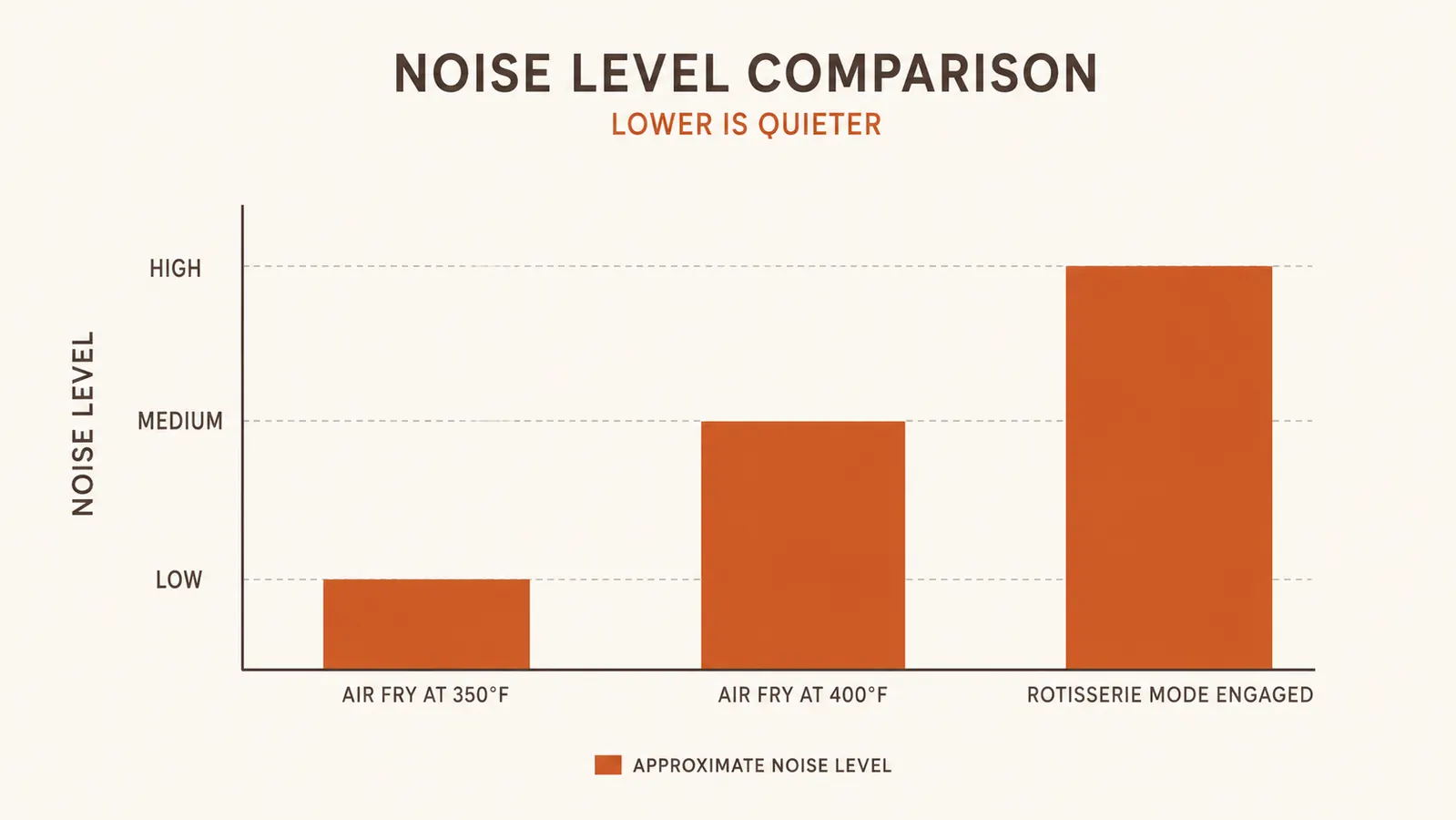
Nobody mentioned this to me before I bought it, probably because most reviews are written after a handful of low-and-slow cooks rather than the higher settings that get real crisping done fast. If you live in a small apartment with thin walls or you're sensitive to appliance noise while working from home, it's worth knowing the Chefman has two very different personalities depending on the temperature you're running it at.
Cleanup: More Steps Than the Box Photo Suggests
The main basket and drip tray on the Chefman are dishwasher safe, and that part of the marketing is accurate. What the listing doesn't mention is the round rotisserie basket accessory, the mesh one meant for smaller items like wings or vegetables, which is not dishwasher safe and needs a hand scrub every single time. Grease sets into the mesh fast, and if it sits overnight before washing, it takes real elbow grease with a bottle brush to get clean again.
There's also a narrow grease channel that runs underneath the heating element, mostly hidden from view unless you actually look for it. I didn't know it existed until my fourth week, when a Sunday rotisserie chicken started producing a faint burning smell partway through the cook. Wiping out that channel, which had collected drippings from earlier cooks, solved it immediately, but it's not something the manual flags clearly, and it's exactly the kind of maintenance step that gets skipped by anyone going off the quick-start card alone.
Once that channel is part of my regular routine, wiped out every week or two depending on how much rotisserie cooking I've done, the whole cleanup process takes maybe ten extra minutes a week compared to my old basket fryer. It's not a dealbreaker, but it's one more example of the gap between how the Chefman looks in a product photo and what actually keeping it running smoothly requires.
What I Liked
- Five presets cover almost every real weeknight meal without guesswork
- Rotisserie produces genuinely crisp skin once the bird is centered properly
- Quiet operation at everyday temperatures under 370 degrees
- Basket and tray are dishwasher safe and clean up fast
- Handled a full eight weeks of near-daily use without any performance drop
Where It Falls Short
- Off-gassing smell during the first two uses that nobody warns you about
- Needs about six inches of clearance above it that under-cabinet spots often don't have
- Stock rotisserie forks can bend under a heavier or off-center bird
- Noticeably louder above 380 degrees or with the rotisserie motor running
- Twelve of the seventeen presets go largely unused in normal cooking
The marketing photos don't lie exactly. They just don't show you the six weeks after unboxing, which is the only part that actually matters.
Who This Is For
If you cook real dinners most nights of the week and you're willing to give an appliance ten minutes of patience during the first two uses while it airs out, the Chefman earns its counter space. It's especially good for anyone replacing an older, noisier basket fryer, or anyone who wants the rotisserie option without buying a second dedicated appliance for it. Just measure your counter and your cabinet clearance before you commit, because the fit matters more than the spec sheet suggests.
Who Should Skip It
If you're sensitive to smell during a break-in period, live somewhere with genuinely thin walls and can't tolerate a louder cook session now and then, or you regularly plan to rotisserie birds heavier than the stock forks are rated for without buying a replacement set, this might not be the easiest fit. It's a solid, honestly flawed appliance, not a miracle, and it rewards people willing to learn its two or three quirks in the first couple of weeks.
Ready to see past the hero shot and decide for yourself?
Check today's price and current availability for the Chefman Multifunctional Digital Air Fryer on Amazon before your next grocery run.
Amazon Check Today's Price on Amazon →