
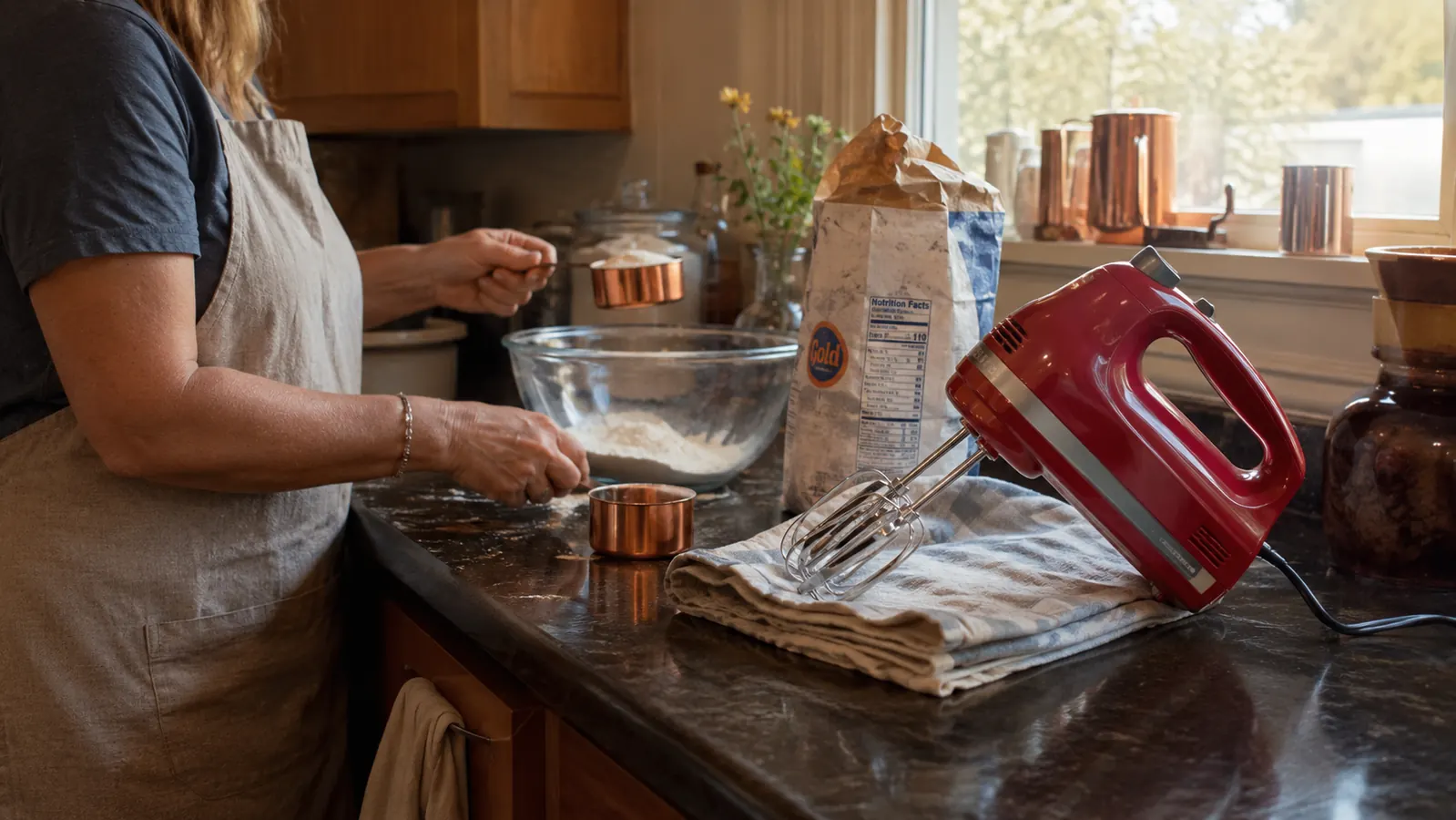
The whisk in my utensil drawer has a bent tine from the year I tried to cream butter and sugar by hand for a batch of sugar cookies and gave up halfway through, arm shaking, butter still lumpy. I kept that whisk around like a trophy of bad decisions until last spring, when my daughter Mia asked for a two-layer birthday cake four days before her party and I realized I did not own a single tool that could get me there without an hour of hand-mixing. I ordered the KitchenAid 5 Ultra Power Speed Hand Mixer that same night, mostly out of desperation, and it arrived two days before the party in a plain box that did not look like it was about to change my weekly baking routine.
A year later it lives in the drawer directly under my stovetop, not buried in the cabinet with the waffle iron and the extra crockpot lid I never found a match for. It comes out most weeks, sometimes twice, and that alone tells you more than a spec sheet could. But since a single sentence review isn't much to build a decision on, here's what actually happened between that frantic birthday cake and this hand mixer earning permanent drawer space in a kitchen where nothing gets to just sit around unused.
For context, my kitchen is small. I have a run of counter about 22 inches wide next to the stove, a stand mixer I inherited from my mother-in-law that's too heavy to pull out for a quick job, and two kids who both want a snack the second they smell anything baking. Whatever I add to my routine has to be fast to grab, fast to clean, and strong enough to actually do the job, not just look nice sitting there.
The Quick Verdict
A genuinely capable everyday mixer that handles cake batter, whipped cream, and cookie dough without straining, though the beater eject button and the storage case both took some getting used to.
Amazon Check Today's Price →Tired of dragging out a heavy stand mixer for a five-minute job?
See today's price and current availability for the KitchenAid 5 Ultra Power Speed Hand Mixer on Amazon before you decide.
Amazon Check Today's Price on Amazon →How I've Used It
I'm not a baker with a following or a test kitchen. I'm someone who bakes for two kids, a husband who requests banana bread on a loop, and the occasional birthday cake that has to look decent enough for photos but doesn't need to win a ribbon at the county fair. My year with the KitchenAid hand mixer wasn't a controlled test, it was my actual counter, the same narrow strip next to the stove, the same overhead light that turns everything slightly orange by six in the evening, and the same rushed twenty minutes I get most weeknights between dinner cleanup and getting the kids into pajamas.
Over twelve months I ran it through birthday cake batter, whipped cream for strawberry shortcake, buttercream frosting more times than I can count, meringue for a lemon pie that mostly worked out, and enough chocolate chip cookie dough to explain why my jeans fit differently than they did last spring. I never followed a formal testing plan. I used the KitchenAid the way I'd use any tool that has to earn its keep on a random Tuesday, which is a harder test than any demo video makes it look.
The five speeds sound like a small detail until you're standing at the counter trying to fold cocoa powder into batter without sending a cloud of it across the backsplash. Starting on speed one and working up saved me from that mess more times than I want to admit, and across a year of weekly use, small conveniences like that add up to a tool I actually reach for instead of avoid.
By the second month I had a rhythm going. Sunday afternoons became muffin batter for the week's lunches, Wednesdays turned into whatever cookie dough the kids were begging for, and birthdays, there have been four in our house this year, all got the same two-layer treatment that started with that first frantic order. That rhythm is the real test of a hand mixer like this one. Anyone can whip cream once for a photo. The question is whether you'll still grab it in month twelve without thinking twice, and I do, almost every week.
Power and the Learning Curve
The first few uses took some adjusting. The KitchenAid's motor is stronger than the cheap hand mixer I'd had years before it died, and on speed five it moves fast enough that I learned quickly to keep the beaters angled down in the bowl before switching it on, or batter ends up flung onto the counter and occasionally onto me. Once I got the habit of starting low and building speed, that stopped being an issue, but it's worth knowing going in that this isn't a tool you can run on high the second it touches the bowl without a little bit of splatter.
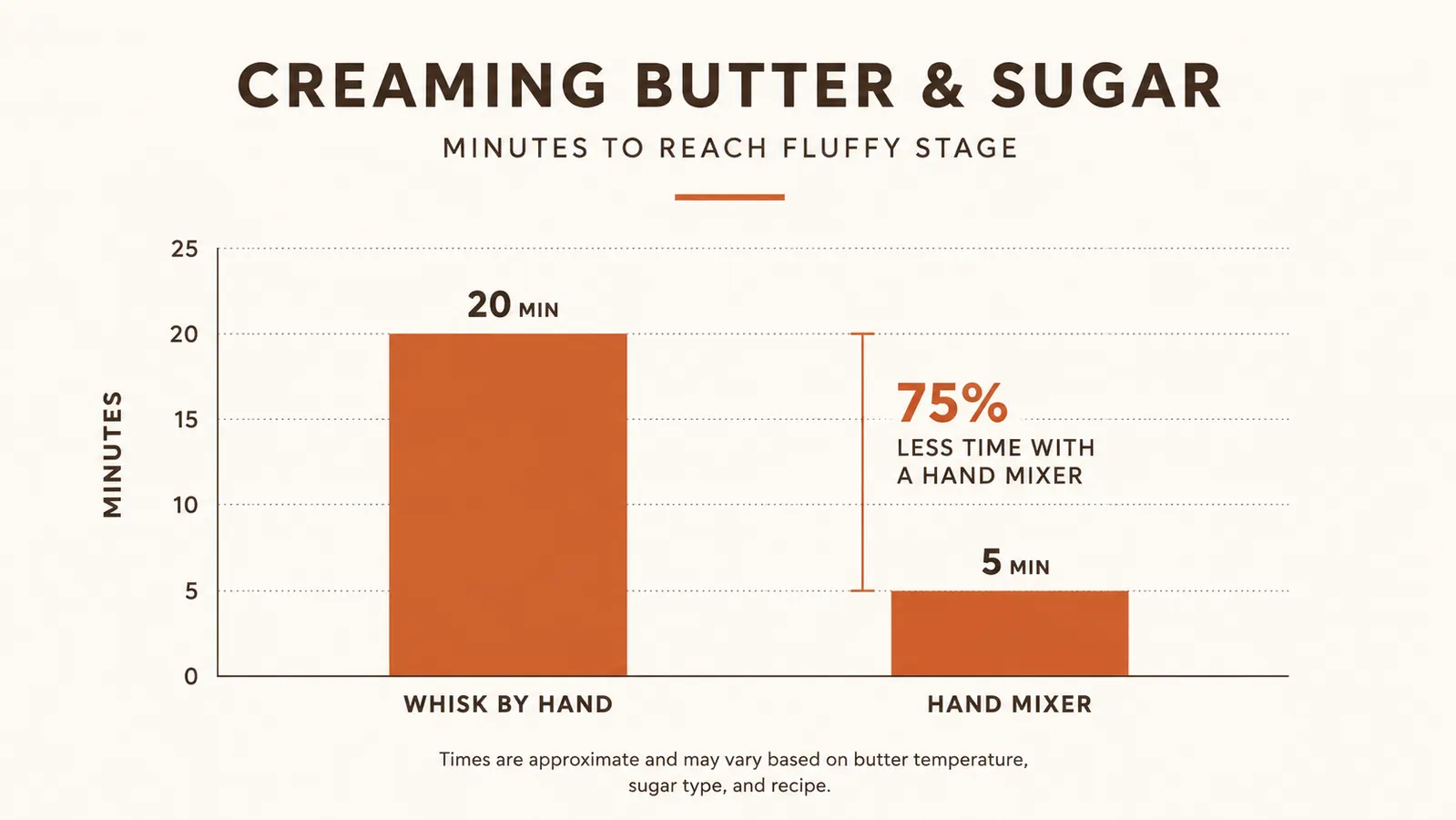
What won me over was creaming butter and sugar, something I'd dreaded doing by hand for years. With the KitchenAid on speed three, cold butter and sugar turn pale and fluffy in about ninety seconds, compared to the five or six minutes of arm burn it used to take me with a whisk. That single difference is probably the reason I bake more often now than I did before, because the most tedious step in almost every recipe stopped being a chore.
The beater eject button surprised me, in a good way once I got used to it. A quick press pops both beaters out over the sink without touching sticky metal with my fingers, which sounds minor until you've done it the old way, wrestling wet beaters off by hand while frosting drips down your wrist. It took me two tries to stop pressing it too hard and flinging a beater across the kitchen, but now it's second nature.
Noise is the other thing nobody mentions until they own one. The KitchenAid runs with a steady hum on the lower speeds, closer to a box fan than anything jarring, though on speed five it does get loud enough that I've learned not to run it while anyone's on a phone call in the next room. Compared to the mixer it replaced, which rattled and whined even on low, this is a noticeable step up, though it's not silent.
Batch Size: Enough for Most Recipes, Not for Doubling Everything
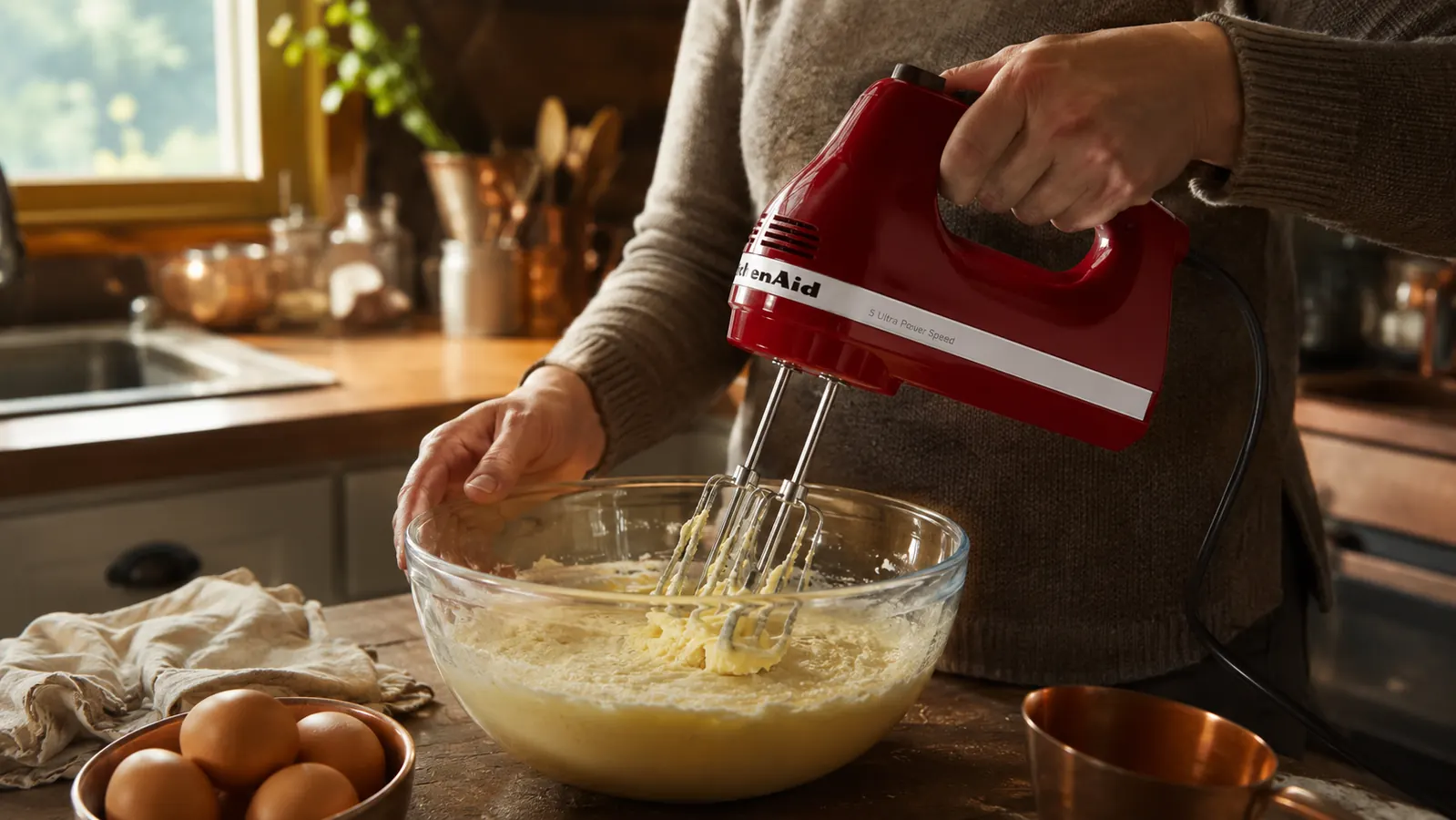
This is where a lot of hand mixer reviews stay vague, so let me be specific. I can comfortably mix a standard two-layer cake batter, roughly six cups total, without the beaters straining or the bowl overflowing. Whipped cream for a full pie tops out fine too. But when I tried doubling a cookie dough recipe to freeze half for later, the motor noticeably slowed and I had to stop halfway through to scrape down the sides more often than usual. For most weeknight and weekend baking, the KitchenAid keeps up. For big batch baking projects, plan on running it in two rounds.
The tradeoff for that everyday-sized capacity is that this stays a hand mixer, not a stand mixer replacement. It's light enough to hold for several minutes without my wrist aching, which matters more to me on a Tuesday than raw power does, but if you're regularly making bread dough or heavy batches, this isn't built for that job and won't pretend to be.
I've also learned that overfilling the bowl, even by a cup or two, is the fastest way to end up with batter on the counter instead of in the bowl. The first time I made a full sheet cake recipe in my regular mixing bowl, half the batter climbed the beaters and landed everywhere but where I wanted it. Switching to a deeper bowl and keeping the KitchenAid at a lower starting speed solved that, but it took one messy Saturday to learn it.
Starting on the lowest speed before ramping up is another habit worth building early. The first couple of times I jumped straight to speed four for whipped cream, it splashed over the rim before it had a chance to thicken. Giving it ten seconds on speed one to incorporate the cream, then building up, keeps everything in the bowl and gets a better texture besides.
Cleanup, Honestly
Cleanup is what decides whether a kitchen tool gets used weekly or turns into drawer clutter. The beaters are dishwasher safe, which matters to me more than almost any other spec on the box, since I'm rarely in the mood to hand-wash sticky metal after frosting a cake at nine at night. On the nights I do hand-wash them, batter and frosting rinse off easily, a year in, with no pitting or rust on the beaters that I've noticed.
The mixer body itself just needs a wipe-down, since the motor housing shouldn't go anywhere near water. The one habit I had to build was drying the beater sockets before storing everything, since a bit of leftover batter dried in there once and made the eject button stick slightly until I cleaned it out properly. Once that became routine, it stopped being an issue.
What Else I Considered
Before landing on the KitchenAid, I looked at two other hand mixers in a similar range. One had a sleeker design but only three speeds, which felt limiting after I started folding delicate ingredients like whipped egg whites. The other had more speed settings but weighed noticeably more, which mattered to me since I'm often holding a mixer one-handed while scraping the bowl with the other.
In the end, the balance of weight, five real speeds, and that beater eject button tipped things in favor of the KitchenAid, even with a short adjustment period on how fast the motor ramps up. I'd rather learn to angle the beaters carefully for a week than spend a year wishing my mixer had more control at the low end.
I also texted my sister, who's been baking for longer than I have, before I bought anything. She'd owned a KitchenAid hand mixer for years and said the only thing she'd change was wishing she'd bought it sooner instead of struggling through birthday cakes with a cheaper mixer that burned out after two Christmases. That kind of plain, unglamorous feedback mattered more to my decision than any comparison chart, and a year in, I think she was right.
I didn't buy this to become a serious baker. I bought it so creaming butter and sugar would stop being the reason I skipped baking a cake from scratch, and that's the only test that actually mattered to me.
What I Liked
- Creams butter and sugar in under two minutes, a real change from mixing by hand
- Beater eject button keeps sticky cleanup off your fingers
- Light enough to hold one-handed through a long mixing session
- Dishwasher-safe beaters make weeknight cleanup realistic
- Five real speeds give enough control for delicate folding and heavier batter
Where It Falls Short
- Motor slows noticeably on doubled or extra-large batches
- Speed five can splatter batter if you don't start low first
- Beater sockets need occasional cleaning or the eject button can stick
- Not a stand mixer replacement for bread dough or heavy jobs
Who This Is For
If you bake for a household of four or fewer, a few times a month or a few times a week, the KitchenAid earns its drawer space. It's built for people who want real power without hauling out a stand mixer for a quick batch of frosting, and the beater eject button alone makes it worth a look for anyone who's tired of wrestling sticky beaters off by hand. If your baking runs toward cakes, cookies, whipped cream, and the occasional meringue, this handles all of it without strain.
Who Should Skip It
If you regularly bake bread from scratch or make large double batches for a crowd, this will frustrate you more than help you. Serious bread bakers need the kneading power of a stand mixer, and this isn't trying to be that. And if you already own a stand mixer you're happy pulling out for everything, you may not need this at all, though I've found mine still gets more weekly use than the heavier mixer it sits next to, simply because it's faster to grab for small jobs.

If creaming butter and sugar by hand has kept you from baking, this is the fix I actually kept using
Check today's price on the KitchenAid 5 Ultra Power Speed Hand Mixer and see if it's in stock for your kitchen.
Amazon Check Today's Price on Amazon →