
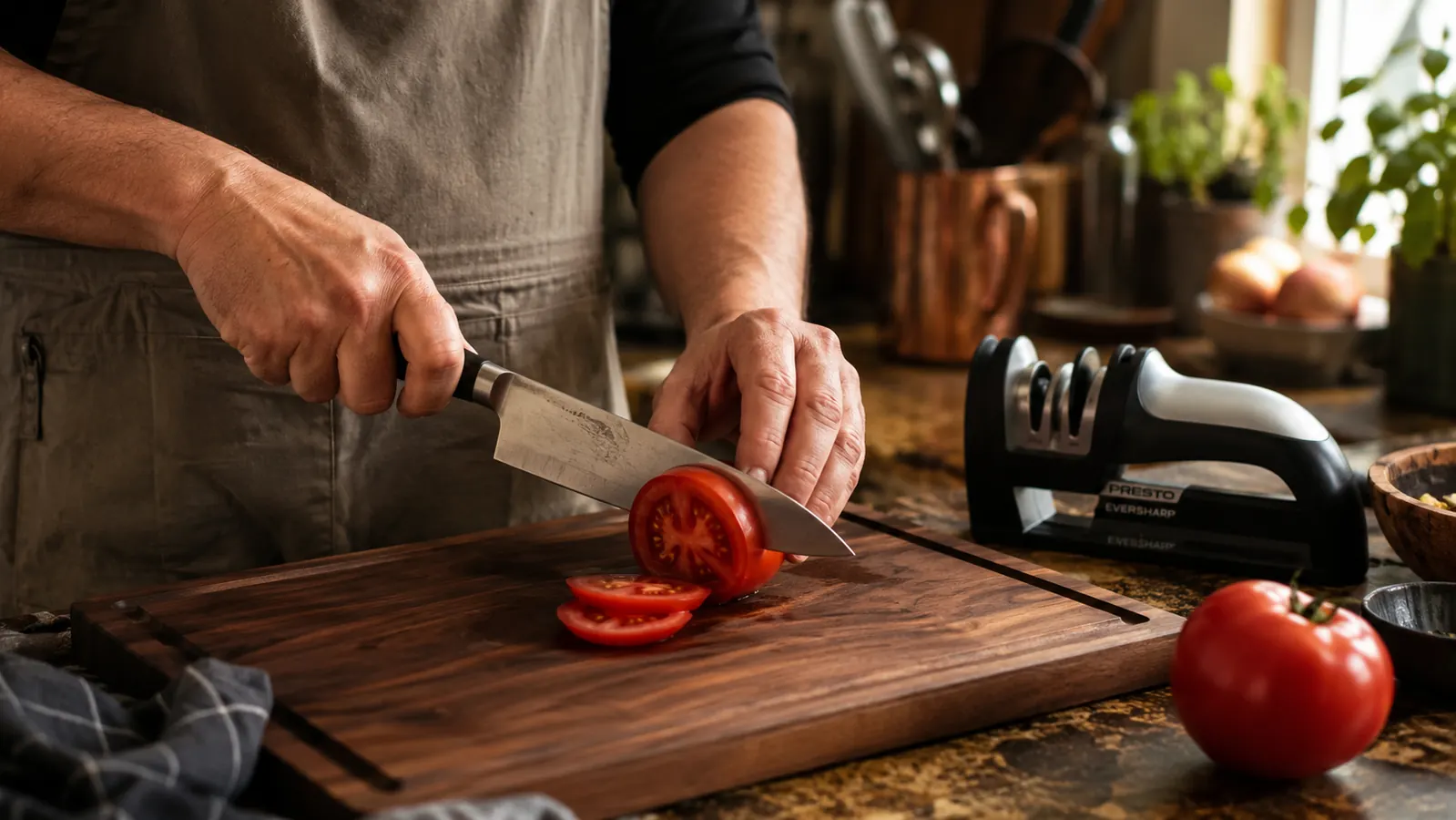
My knife drawer used to have a rotation problem. Every knife in it, the chef's knife, the paring knife, even the bread knife, went dull within a few weeks of buying it, and I kept sawing through tomatoes and telling myself I'd deal with it later. I finally dealt with it by buying a Presto EverSharp electric knife sharpener, and it sat next to a whetstone I already owned but almost never used. Six months later I have a clear answer about which one earns counter space in a weeknight kitchen, and it's not as simple as 'the electric one is easier.' Here's what actually separates them once you're standing at the cutting board at 6 pm.
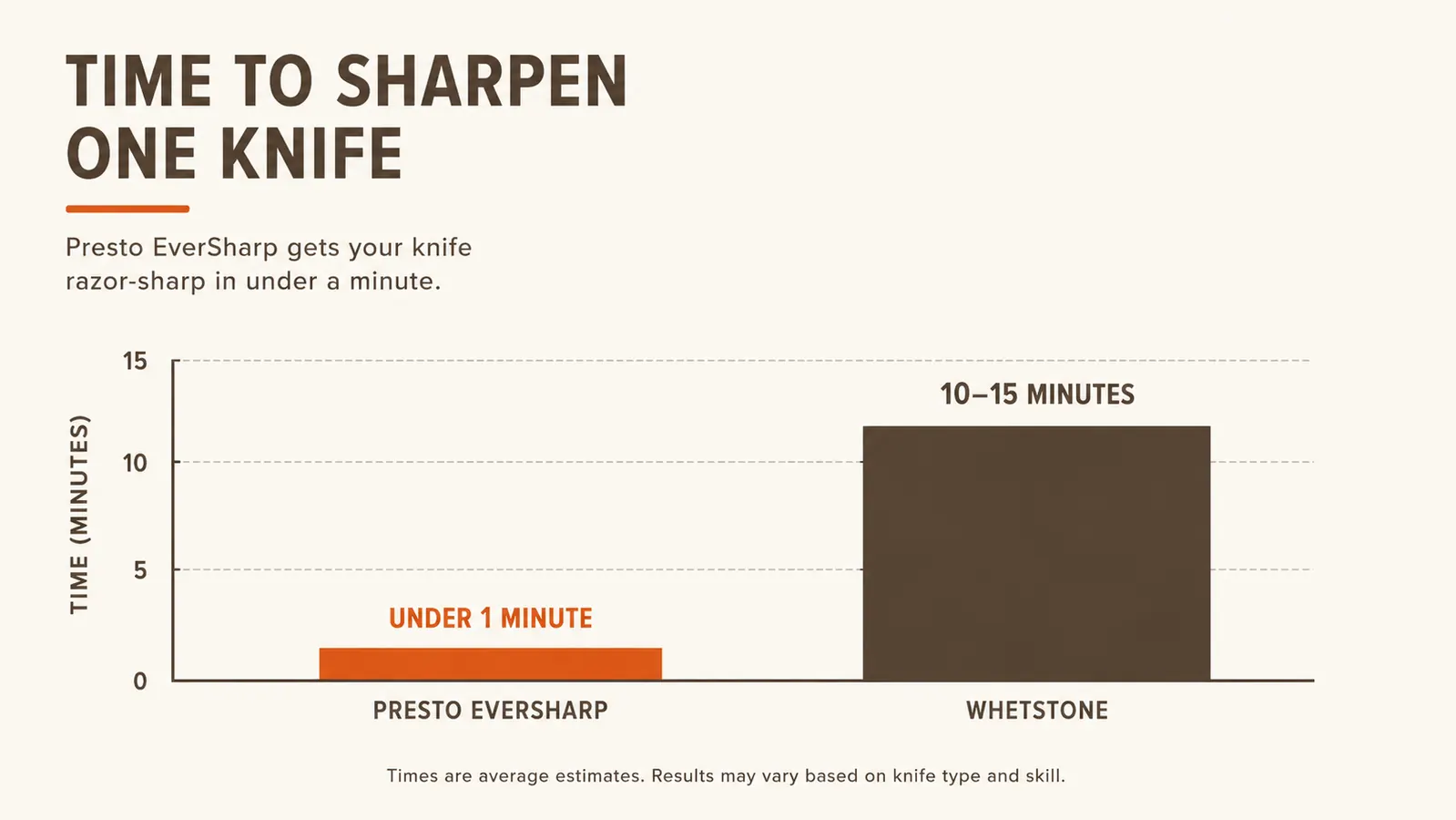
If I only get thirty seconds before dinner needs to start, the Presto EverSharp wins outright. It pulls the blade through two sharpening stages and a honing stage, and a knife that was sliding off tomato skins comes out slicing through them in under a minute. A whetstone gets you a better edge if you're willing to spend ten minutes learning to hold a consistent angle, but that patience is the whole tradeoff. This comparison is about which tool actually gets used on a Tuesday, not which one wins in a knife forum argument.
How I Actually Tested Both
I ran this test with the same three knives every time: an 8-inch chef's knife, a serrated bread knife, and a cheap paring knife that came free with a set. Each knife went dull doing the exact same job, cutting through a normal week of dinners, then got sharpened on the Presto EverSharp one week and the whetstone the next. I timed every sharpening session, tested the edge on a ripe tomato and a sheet of paper right after, and checked again three days later to see how long the edge actually held up.
The whetstone I used is a basic two-sided combination stone, coarse on one side for repair work and fine on the other for polishing the edge, the kind sold in most kitchen stores. It needs water or oil before you start, and it needs a flat, stable surface, which in my kitchen meant clearing counter space and putting down a towel so it wouldn't slide around while I worked. That setup step alone changes how often a tool gets picked up on a busy weeknight.
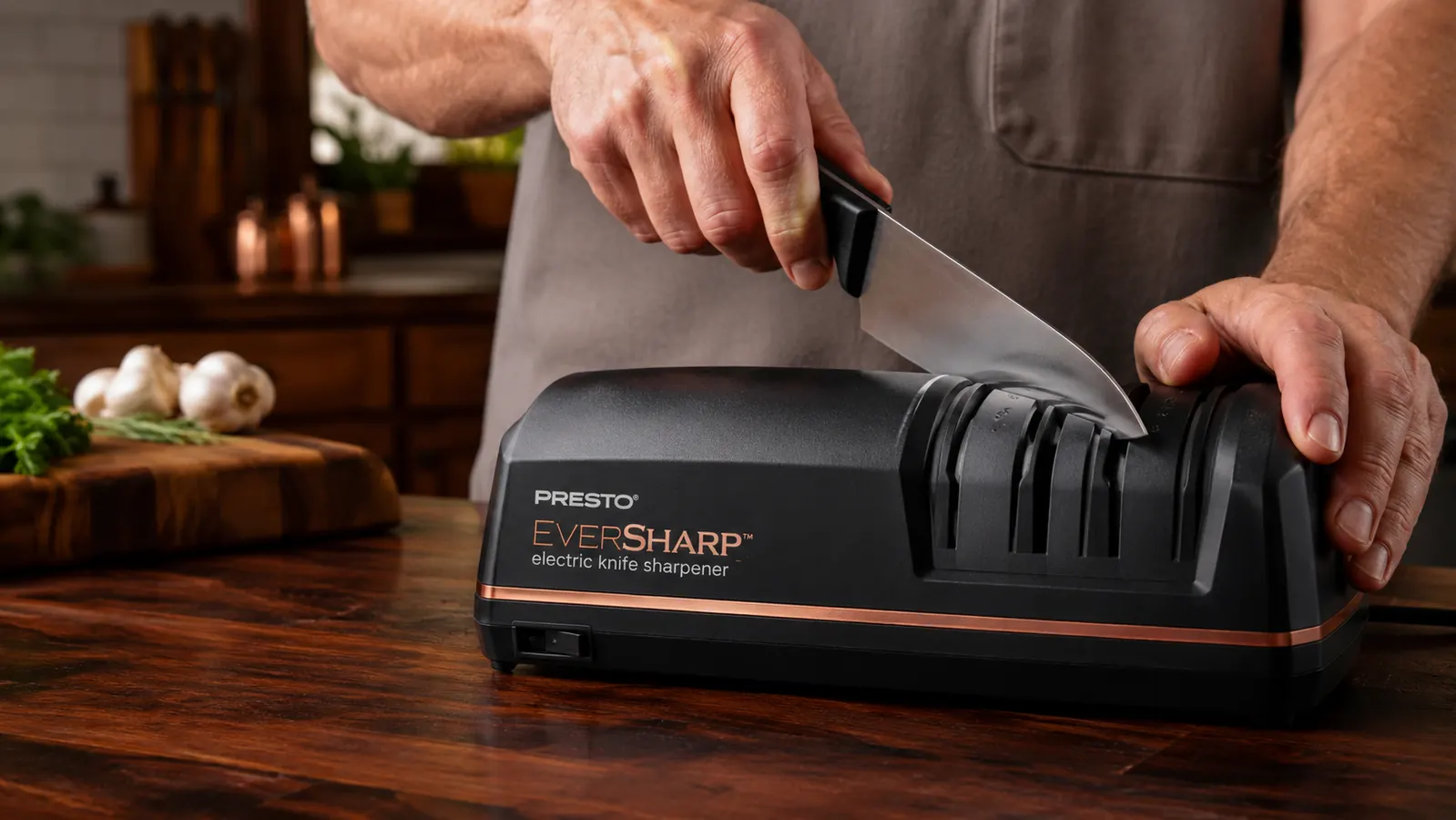
Neither tool got a free pass on technique. The Presto EverSharp still requires you to pull the blade through at a steady pace and a consistent angle relative to the guide slots, and rushing it or tilting the blade sideways scratches the edge instead of sharpening it. The whetstone requires that same steady pull, just with your whole arm controlling the angle instead of a guide doing it for you. That difference in who's actually holding the angle is the entire story of this comparison.
A Practical Note on Safety
A note on safety since we're talking about blades: both tools ask you to guide a sharp edge past your fingers, so slow down more than feels necessary the first few times. The Presto EverSharp's slots keep your hand well clear of the blade path, which is part of why I trust it for a quick sharpening even when I'm distracted mid dinner prep. A whetstone puts your fingers closer to the edge since you're controlling the angle directly, so I keep a towel under the stone for grip and never sharpen when I'm rushed or the kitchen is chaotic. Neither tool is dangerous if you go slow, keep your fingers behind the edge, and pay attention to what your hands are doing.
| Presto EverSharp Electric Sharpener | Whetstone | |
|---|---|---|
| Time to sharpen one knife | Under 1 minute across three guided stages | 10 to 15 minutes with practiced technique |
| Skill required | Feed the blade through marked slots, no angle-judging | Steady freehand angle control, takes weeks to learn |
| Consistency between sessions | Same result every time thanks to fixed guide angles | Varies with hand steadiness and experience |
| Edge fineness at its best | Solid working edge for everyday cutting | Finer, more polished edge with skilled use |
| Metal removed per sharpening | More aggressive removal on the coarse stage | Minimal removal on fine-grit touch-ups |
| Setup and storage | Plugs in, sits on the counter or tucks in a drawer | Needs water or oil and a stable flat surface |
| Noise while sharpening | Audible motor whir | Silent |
| Best fit for | Weeknight cooks who want fast, reliable results | Cooks who enjoy the process and own a knife worth the extra care |
Where the Presto EverSharp Wins
Speed is the obvious one. A dull chef's knife goes from sliding off a tomato to slicing clean through it in under a minute with the Presto EverSharp, start to finish, including pulling it out of the drawer. On a whetstone, the same result takes ten to fifteen minutes if you already know what you're doing, longer if you don't. When dinner is already running late and a knife won't cut through an onion without smashing it, that time difference is the whole reason the Presto EverSharp gets used weekly instead of quarterly.
Consistency is the other one. The Presto EverSharp's guide slots hold the blade at a fixed angle through each of its stages, coarse sharpening, fine sharpening, and honing, so the result doesn't depend on how steady my hand is on a Tuesday versus a Sunday. My edges come out close to identical every time. A whetstone rewards practiced technique and punishes an off day, wobble the angle for even a few strokes and you round the edge instead of sharpening it, which is exactly what happened to my paring knife the first two times I tried.
It also asks nothing of me technically. I don't have to know what a proper sharpening angle feels like or hold it steady through forty strokes per side. I feed the knife in, pull it through the slots in order, and I'm done. For a home cook who's cooking dinner most nights and not treating knife care as a hobby, that's the difference between a sharpener that gets used and one that turns into a guilt object sitting in a drawer.
Where the Whetstone Wins
Edge quality at the finest level goes to the whetstone. A skilled pass on the fine-grit side removes a thinner layer of metal and leaves a smoother, more polished edge than any electric sharpener I've used, the Presto EverSharp included. If you cook with a knife you actually love, a nicer chef's knife you plan to keep for a decade, that finer edge and the control over exactly how much metal comes off matters in a way it doesn't for a knife that came free in a starter set.
It's also gentler on the blade over time. The Presto EverSharp's coarse stage removes noticeable metal every time it's used, which is fine occasionally but adds up if you sharpen weekly instead of only when a knife actually needs it. A whetstone lets you do light touch-up passes on the fine side alone, maintaining an edge without grinding down the blade, which is the reason serious knife owners keep one around even after they've bought an electric option purely for speed.
There's no motor, no cord, and nothing to plug in, which matters if the counter outlets are already full or you just don't want one more electric gadget taking up a spot. A whetstone stores flat in a drawer, doesn't wear out mechanically, and doesn't have sharpening wheels that eventually dull themselves. If you already own one, or you can find one cheaply, there's a real argument for keeping it around purely as a backup that never breaks down.
Storage, Cleanup, and the Small Stuff
Cleanup on the Presto EverSharp takes about ten seconds, a quick wipe with a dry cloth to clear metal shavings off the sharpening slots, and it's done. It sits upright in a cabinet or lies flat in a drawer, and there's nothing to dry out or maintain between uses. The whetstone needs a rinse and a full air-dry before it goes back in a drawer, since storing it damp next to other tools isn't great for the stone or anything metal nearby, which adds a small extra step most nights.
Neither tool takes up much room, which surprised me going in. I'd assumed the electric sharpener would be the bulkier option, but the Presto EverSharp is about the size of a stapler and tucks into the same drawer as measuring cups. The whetstone is flatter but needs its own protective sleeve or box so the surface doesn't get scratched by silverware sharing the drawer. Either way, this comparison isn't decided by which one takes up more counter space, because in a normal kitchen, both fit easily.
Tired of Sawing Through Tomatoes Instead of Slicing Them?
The Presto EverSharp brings a dull chef's knife back to a working edge in under a minute, no angle-guessing required.
Amazon Check Today's Price on Amazon →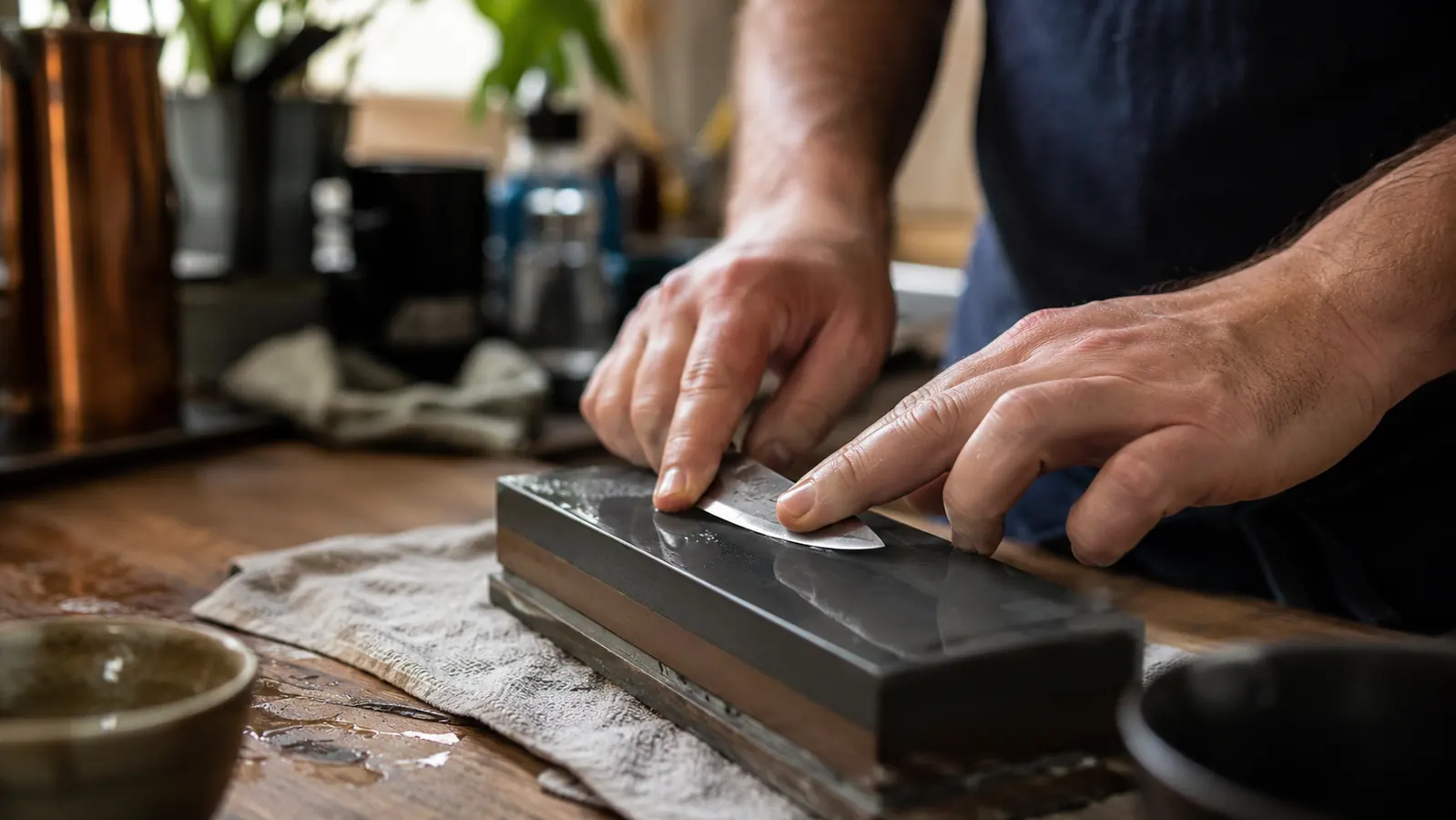
The Skill Gap Nobody Mentions
What gets left out of most whetstone recommendations is how long it actually takes to get good. My first few sessions produced uneven edges, a slightly rounded tip on the paring knife, and one session where I made a knife duller than when I started because I held the angle wrong on the coarse side. Nobody warns you that whetstone sharpening has a real learning curve measured in weeks of practice, not one video. The Presto EverSharp skipped that entire curve for me on day one.
That's not a knock on whetstones themselves, plenty of home cooks get genuinely good at it and prefer the control it gives them. But if you're picking a sharpener because your knives are dull right now and dinner is in twenty minutes, the learning curve is the real cost you're paying, not just the time per session. It's worth being honest about that before deciding a whetstone is automatically the better choice just because serious cooks recommend it.
The whetstone taught me patience. The Presto EverSharp is the one I actually reach for on a Tuesday.
Who Should Buy Which
If you cook most nights, own a handful of everyday knives, and want them reliably sharp without turning it into a project, the Presto EverSharp is the better fit. It's the tool that actually gets used on a Tuesday, which matters more than which one produces the theoretically sharper edge in a lab setting. If you own one or two knives you genuinely love, you enjoy the process of sharpening as its own small ritual, and you're willing to practice, a whetstone rewards that patience with an edge quality the Presto EverSharp doesn't fully match at its finest setting.
A lot of home cooks end up keeping both, which is what happened in my kitchen. The Presto EverSharp handles the weekly maintenance on the knives that see daily use, and the whetstone stays in a drawer for the one knife I care enough about to slow down for. That combination costs less counter space than it sounds like, and it solves both problems instead of forcing a choice between them.
Stop Guessing at Angles With a Dull Knife in Your Hand
See today's price on the Presto EverSharp electric knife sharpener and get every knife in the drawer back to a working edge tonight.
Amazon Check Today's Price on Amazon →