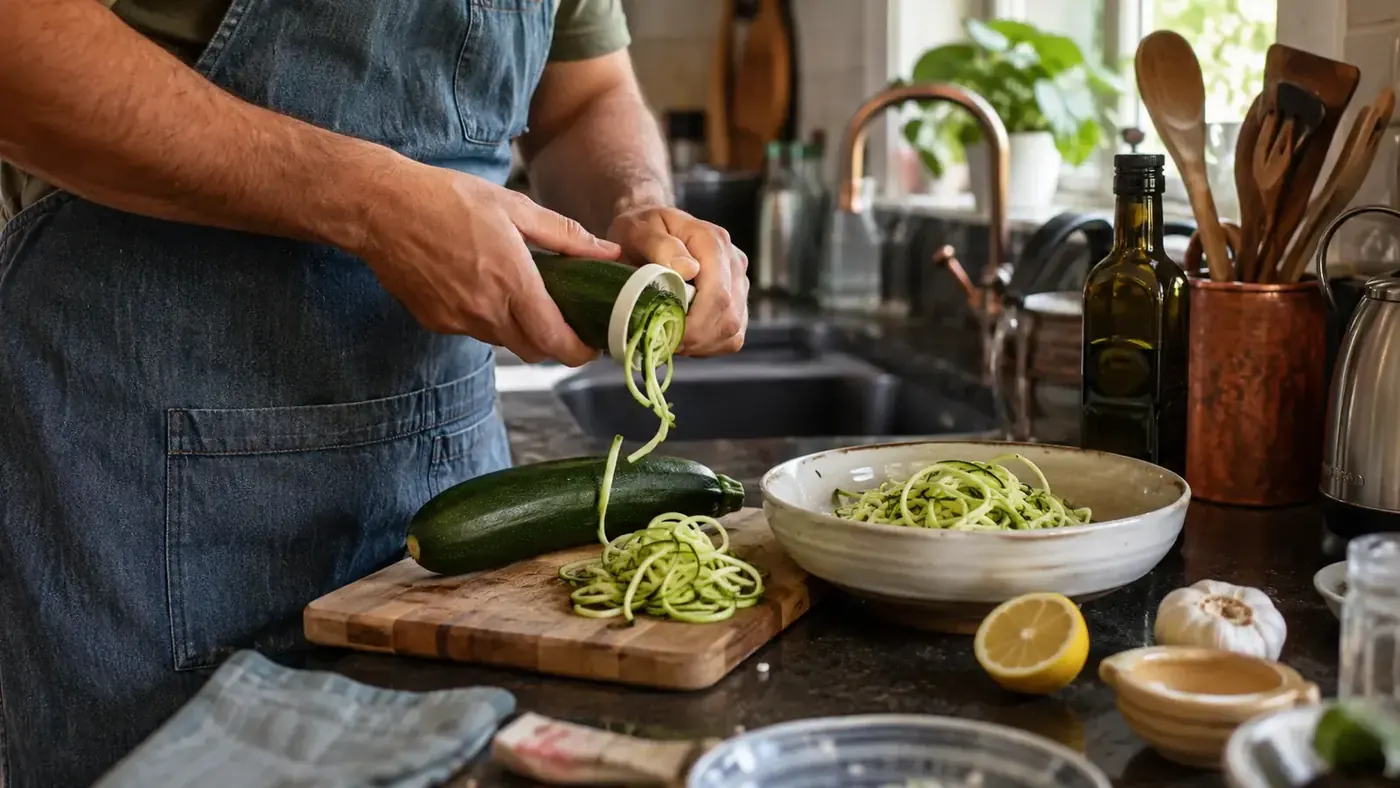
There's a spot in my crisper drawer where good vegetable intentions used to go to die. I'd buy zucchini and sweet potatoes on a Sunday, tell myself I'd use them all week, and then find them soft and sad the following Saturday when I was clearing out for the next grocery trip. I bought the Brieftons 5-Blade Vegetable Spiralizer back in January mostly out of guilt, and partly because a friend swore her kids ate more vegetables once she started turning them into noodles instead of serving them steamed and sitting on the plate untouched.
Six months later the Brieftons spiralizer lives in the cabinet next to my stove, not buried in the drawer under the stove where appliances go to be forgotten, and I use it two to three times a week. That's the short version. The longer version is everything that happened between unboxing the Brieftons and it becoming a normal part of how I get vegetables onto the table on an ordinary Tuesday, not a special occasion.
For context, my kitchen has about 20 inches of counter space next to the sink and a family of four who eat dinner at slightly different times depending on who has practice or a late meeting. Anything that lands on my counter or in my everyday cabinet has to earn it fast. This isn't a review from someone with a test kitchen and unlimited storage. It's from someone deciding whether a five-blade spiralizer is worth the space it takes up next to the colander.
The Quick Verdict
A sturdy, genuinely useful way to turn zucchini, sweet potatoes, and cucumbers into noodles and ribbons, though the suction base needs a truly flat counter and the thickest blade takes some arm strength to crank through dense vegetables.
Amazon Check Today's Price →Tired of watching good vegetables go soft in the crisper before you use them?
See today's price and current availability for the Brieftons 5-Blade Vegetable Spiralizer on Amazon before you decide.
Amazon Check Today's Price on Amazon →How I've Used It
I'm not someone who meal preps five perfect containers on a Sunday afternoon. I'm someone who looks in the fridge at 5:40 on a weeknight and works out what can become dinner in the next 30 minutes. My testing of the Brieftons wasn't a controlled kitchen trial, it was six months of real weeknights, the same counter, the same rushed window between picking a kid up from soccer and getting food on the table before homework starts eating into the evening.
Over that stretch I ran zucchini through it more times than I can count, along with sweet potatoes, cucumbers, carrots, and one memorable attempt at a daikon radish that turned out better than I expected. I didn't follow a recipe card for any of it. I used the spiralizer the way I'd actually use a kitchen tool that has to prove itself against my patience on a random Tuesday, which is a harder test than a food blog demo where everything is already sliced and arranged.
By week two I had a rotation going. Zucchini noodles under Sunday's leftover marinara became a regular Monday dinner. Sweet potato ribbons roasted with a little olive oil and cinnamon turned into a side my kids actually ask for, which still surprises me. Cucumber ribbons in a quick vinegar dressing became my go-to for nights when I didn't want to turn the oven on at all. That rotation is the real test of whether a gadget like this earns its keep, and six months in, it has.
The moment I actually trusted the Brieftons came in March, when my youngest asked for pasta three nights in a row and I quietly swapped half the plate for zucchini noodles mixed in with the real thing on night two. Nobody complained, nobody noticed until I mentioned it a week later, and that's when I stopped thinking of this as a novelty gadget and started thinking of it as a regular way to get more vegetables into a meal without turning dinner into a negotiation.
The Blades and the Learning Curve
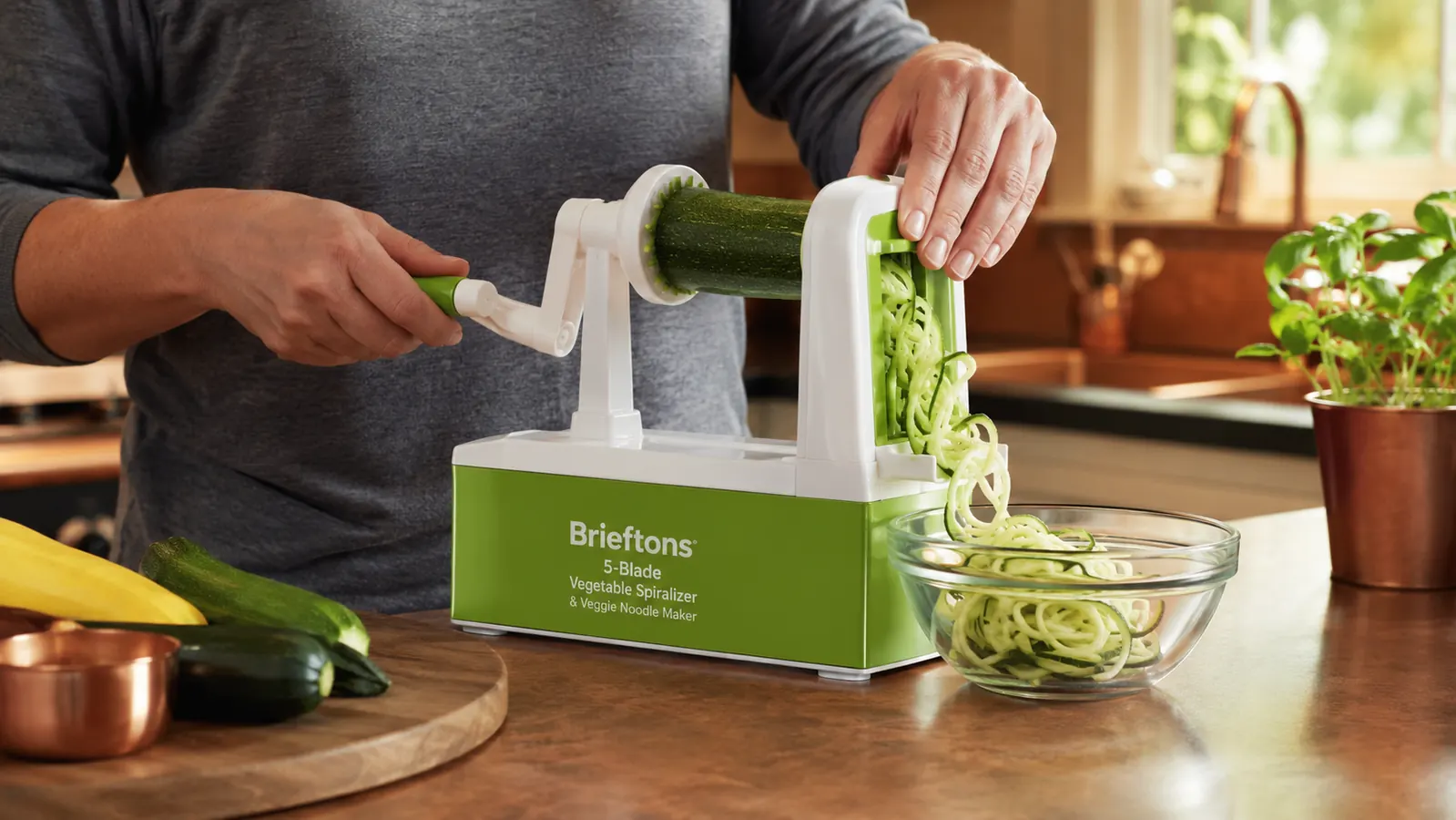
The Brieftons ships with five interchangeable blades, ranging from thin angel-hair-style strands to a thick ribbon cut, plus a slicing blade for flat rounds. The first week was rockier than I expected. Locking the right blade into the housing takes a firm push and a twist that felt awkward until I'd done it a handful of times, and I definitely cranked a zucchini through the wrong blade twice before I got a feel for which one made what shape. Once that clicked, swapping blades between vegetables became a 20-second job instead of something I dreaded.
What won me over was how differently the blades handle different vegetables. Zucchini spiralizes almost effortlessly on any blade, soft enough that the crank turns smoothly the whole way through. Sweet potatoes are a different story. They're dense, and the thickest ribbon blade takes real forearm effort to push through a firm one, especially toward the end of the vegetable when there's less to grip. It's not a dealbreaker, but if you have limited hand strength or a wrist issue, it's worth trying a softer vegetable first before committing to sweet potatoes as your regular use case.
The suction-cup base is the other thing that took adjusting to. On my laminate counter it holds firm and doesn't budge even when I'm cranking hard through a sweet potato. On my sister's textured granite, when I brought it over for a family dinner, it slid around enough to be annoying, and I ended up bracing the base with one hand while cranking with the other. If your counter has any texture to it, know that going in, because a spiralizer that skates across the counter mid-crank isn't just inconvenient, it's a little unsafe with a blade housing that close to your hand.
Capacity and What It Actually Handles
This is where a lot of spiralizer reviews stay vague, so let me be specific. One medium zucchini, roughly 8 inches long, produces enough noodles for one generous adult serving. For my family of four I typically run three medium zucchini through the Brieftons back to back, which takes about six minutes once you're used to the motion. Sweet potatoes are slower going because of the density, and I budget closer to ten minutes for enough ribbons to feed everyone.
Not everything spiralizes well, and I learned that the hard way with a few failed attempts. Cucumbers work great but need the seeds scraped out first or the core falls apart mid-crank. Carrots need to be thick and straight, thin or curved ones spin off-center and produce short, broken pieces instead of long noodles. Butternut squash is too hard for me to push through comfortably without pre-softening it slightly in the microwave first, which felt like an extra step I hadn't planned on when I bought this to save time, not add to it.
The core that's left after spiralizing, especially with zucchini and cucumbers, is bigger than I expected the first time. I was tossing a surprising amount of usable vegetable in the trash until I started saving cores for soup stock instead. That's not a flaw in the Brieftons itself, more a heads-up that spiralizing does create some waste you'll want a plan for if you're trying to stretch your grocery budget.
As for storage, the whole unit breaks down into the base, the food carriage, and however many of the five blades you actually keep on hand day to day. I store mine assembled with just the two blades I use most, zucchini noodle and ribbon, in a shallow cabinet next to my baking sheets. The other three blades live in a small zip pouch in a drawer, and I've reached for the slicing blade maybe four times in six months, mostly for cucumber rounds when I wanted something flatter than a ribbon for a salad.
Cleanup, Honestly
Cleanup determines whether a gadget gets used weekly or becomes drawer furniture, and this is where the Brieftons mostly holds up. The blades, the food carriage, and the base all come apart for cleaning, and everything except the blades themselves goes in the dishwasher's top rack without issue. The blades I hand-wash, because they're genuinely sharp and I don't love the idea of fishing them out of a dishwasher rack by feel.
Hand-washing the blades takes about two minutes with a dish brush, longer than I'd like but not enough to make me skip using the spiralizer on a busy night. The one real annoyance is vegetable pulp getting stuck in the fine teeth of the thinnest blade, which needs a firmer scrub than the others. A few months in I started rinsing the blade immediately after use instead of letting it sit in the sink, and that alone cut my cleanup time almost in half.
Who Else I Considered
Before landing on the Brieftons, I looked at two other spiralizers in a similar price range. One was a smaller handheld version that looked easier to store, but reviews mentioned it struggled with anything larger than a thin carrot, which would have ruled out sweet potatoes entirely. The other was a countertop model with a motor instead of a hand crank, which sounded appealing until I read that the motor struggled with dense vegetables and needed frequent pauses to avoid overheating.
In the end, the five interchangeable blades and the manual crank tipped it in favor of the Brieftons for me. A hand crank means I control the speed and can feel when a vegetable is fighting back, which matters more than it sounds like it would once you've had a motor jam mid-cook on a night you're already running late. I also asked a neighbor who'd owned a spiralizer for years what she'd change about hers, and she said she wished she'd bought one with more blade options from the start instead of upgrading later. That confirmed blade variety was worth prioritizing over a slightly sleeker design.
I didn't buy this to become a different kind of cook. I bought it so the zucchini in my crisper drawer would actually get eaten, and six months in, that's exactly what's happened.
What I Liked
- Five interchangeable blades cover noodles, ribbons, and flat slices
- Manual crank gives more control than the motorized models I considered
- Handles zucchini and cucumbers with almost no effort once you know the blade
- Suction base holds firm on a smooth laminate or wood counter
- Most parts are dishwasher safe, cutting real cleanup time
Where It Falls Short
- Suction base can slide on textured or uneven countertops
- Dense vegetables like sweet potato and squash take real arm strength
- Fine-tooth blade needs a firmer hand scrub or pulp sticks in the teeth
- Locking the blade housing takes practice the first week
Who This Is For
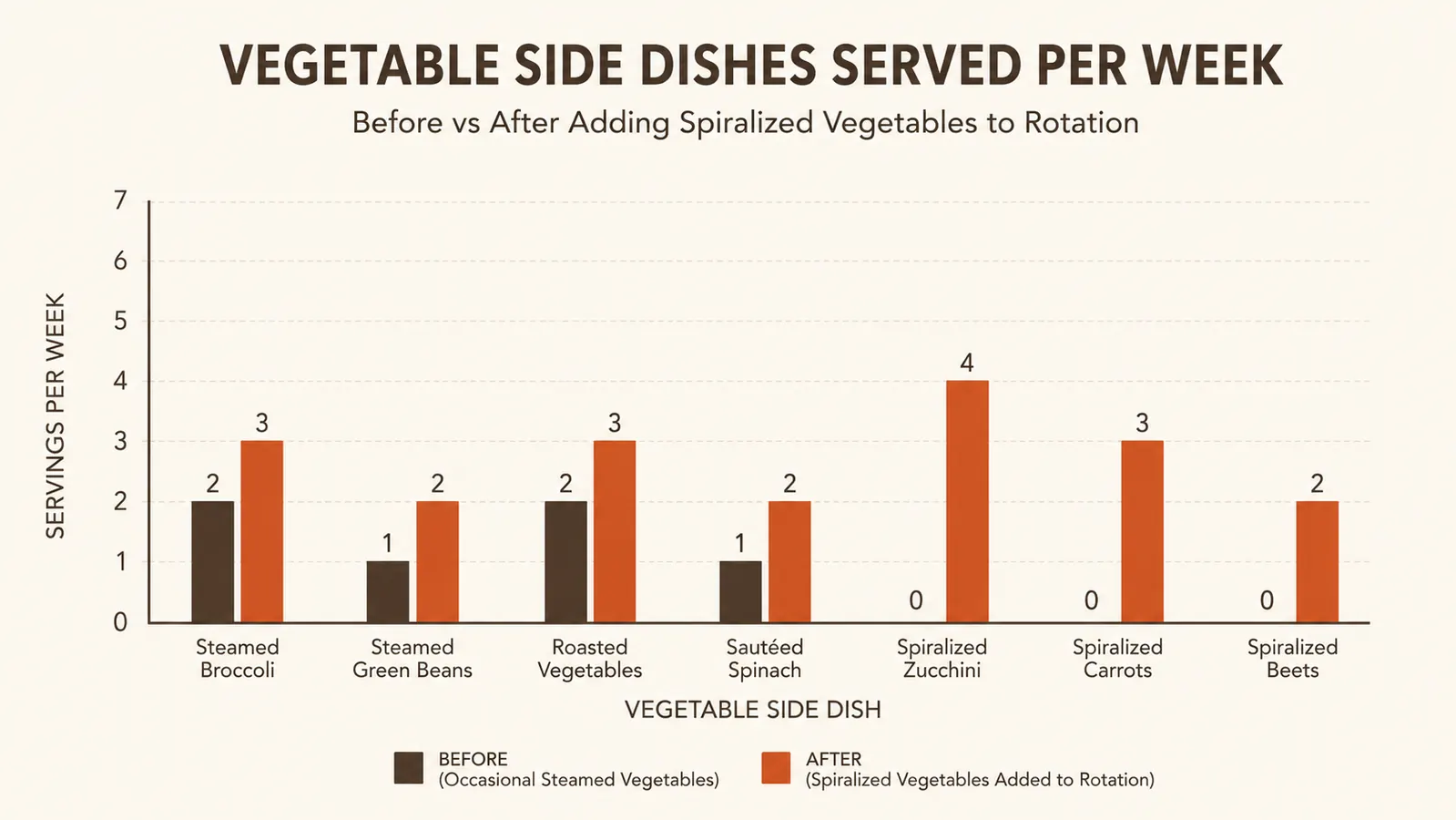
If you're anything like me, someone who buys vegetables with good intentions and then watches half of them go soft before you get around to using them, the Brieftons is worth the cabinet space. It's built for people who want a hands-on tool they control, not a motorized gadget with one setting. If you're already comfortable with zucchini, cucumbers, and carrots in your weekly grocery haul and you're looking for a way to make them feel like a different dish instead of the same steamed side every time, this earns its spot.
Who Should Skip It
If your counters are textured stone or an uneven surface with no smooth spot for a suction base, you'll spend more time bracing the spiralizer than actually using it, and that gets old fast. If wrist or hand strength is a concern, the dense vegetables that make this most useful, sweet potatoes especially, may be more frustrating than satisfying to crank through by hand. And if you're mainly cooking for one person, the setup and cleanup time per use might not pencil out against how much noodle output you actually need on a given night.

If good vegetables keep going soft before you use them, this is what changed that for me
Check today's price on the Brieftons 5-Blade Vegetable Spiralizer and see if it's in stock for your kitchen.
Amazon Check Today's Price on Amazon →