

My knife drawer used to be where good intentions went to die. I'd buy a decent chef's knife, use it hard for about six weeks, and then just keep using it dull because sharpening felt like a whole project I didn't have time for on a Sunday night. That's the honest starting point for this review: I am not a knife person. I'm a person who cooks dinner most nights of the week on a counter that's really just a few feet of laminate next to the stove, and I bought the Presto EverSharp electric knife sharpener because I was tired of watching my knife bounce off a red onion instead of slicing straight through it.
It's been a little over a year now, so this isn't a first-impressions post. I've run it on my 8-inch Wusthof chef's knife probably two dozen times, on my husband Dennis's old hunting knife twice (don't ask), and on a drawer full of cheap paring knives more times than I can count. What follows is the stuff that didn't show up in the other reviews I read before I bought it, the parts that actually matter once the box is unpacked and the Presto is just another appliance living on your counter.
The Quick Verdict
A genuinely useful two-stage sharpener that gets kitchen knives working again fast, but the coarse slot is more aggressive than the marketing suggests, and it's louder and messier than I expected going in.
Amazon Check Today's Price →Tired of Fighting a Dull Knife Every Night?
The Presto EverSharp turns a five-minute chore into a two-minute one. Check today's price and see if it's in stock before your next prep session.
Amazon Check Today's Price on Amazon →How I've Used It
I keep the Presto EverSharp in the cabinet under the coffee maker, which tells you something: it's not precious enough to hide away in a closet, but it's not attractive enough to leave out on the counter either. It's a plain white and gray plastic housing with two slots, coarse and fine, sitting on a small rubber-footed base that's supposed to keep it from sliding around while it runs. Mine still creeps an inch or two every time I use it, so I've gotten in the habit of bracing it against the backsplash before I start.
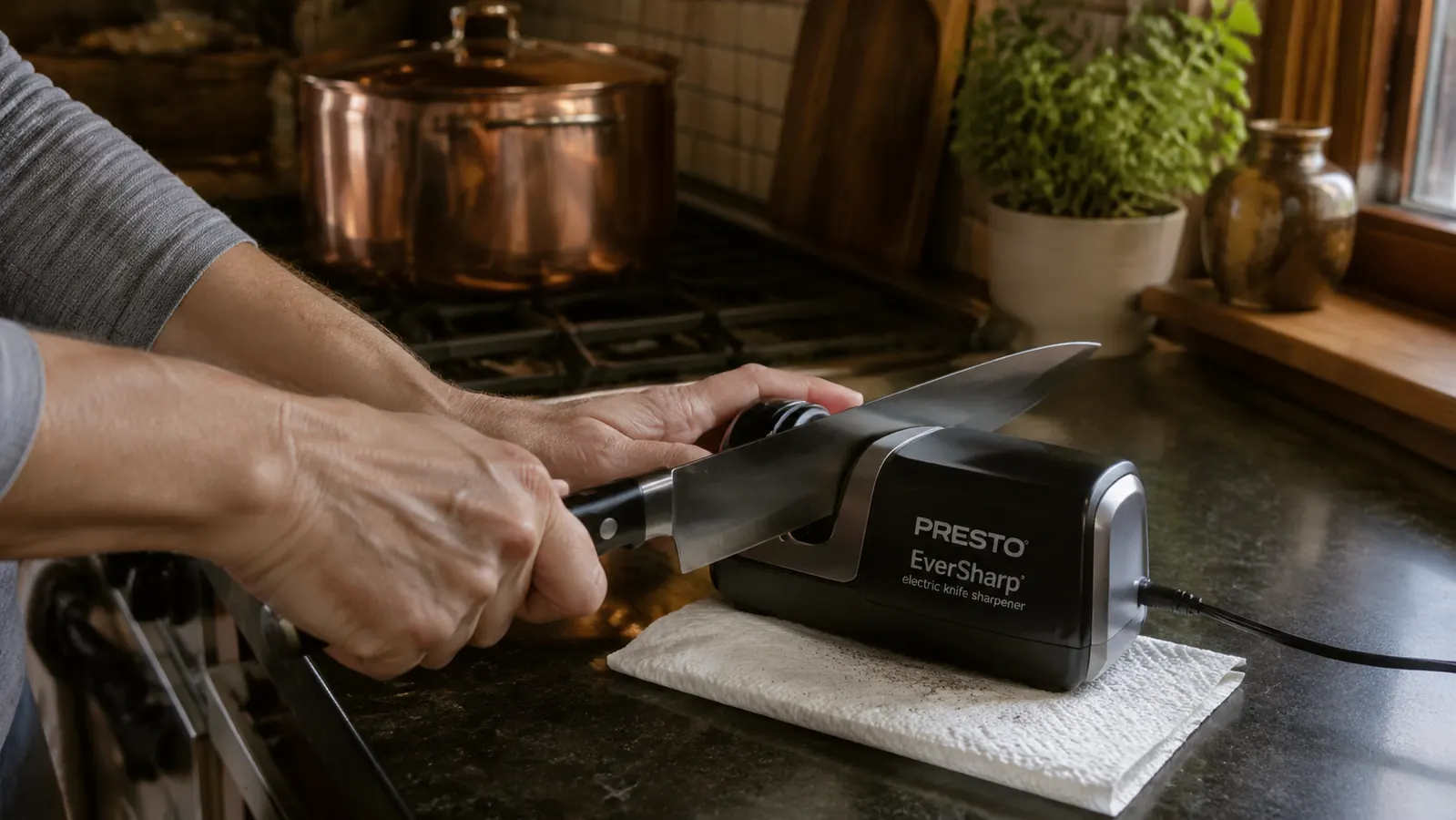
The routine itself is simple enough that I don't dread it, which is really the whole point. Knife goes into the coarse slot at the angle the guide sets for you, pull through five or six times with light, even pressure, then move over to the fine slot for another four or five pulls. Wipe the blade down, done. Total time, including digging the thing out of the cabinet, is maybe three minutes.
The first day I owned it, I skipped the little instruction card entirely and just started pulling my dullest paring knife through both slots, guessing at how much pressure to use. It came out fine, actually better than fine, and that set an expectation of foolproof simplicity that's mostly held up over the following year, aside from the noise and mess lessons I learned the slow way, one paper towel at a time.
What I didn't expect after a full year is how much the coarse stage actually removes. The first time I ran my chef's knife through it, after months of neglect, I watched a visible streak of gray metal filings collect on the paper towel I'd tucked underneath. That's just how motorized abrasive systems work, but nobody selling one puts a photo of the metal shavings on the box.
What Nobody Tells You About the Guides
The angle guides are the whole selling point of an electric sharpener like this one. They're supposed to remove the guesswork of holding a steady angle by hand, and mostly, they do. But the guides on the Presto EverSharp are firm plastic, not adjustable, and after a year of regular use mine have visible wear grooves where the blade rides through. I don't think it's throwing off the angle in any way I can actually measure, but it makes me wonder how they'll hold up by year three.
The bigger issue is that the guide assumes a fairly standard western chef's knife profile. My Wusthof fits it well. My mother-in-law's old carbon steel santoku, thinner and with a steeper factory edge, doesn't sit in the slot the way the diagram in the manual suggests it should. I sharpened it anyway the first month I had the machine, and I regret it a little. The edge came out serviceable but nowhere near as fine as it started.
If you cook with a mixed set, mostly western-style knives with one or two specialty blades in the mix, budget for those specialty ones needing a different tool entirely. The Presto EverSharp is built for the knives most people actually own, not the outliers sitting in the back of the block.
The Noise and Mess Nobody Mentions
This thing is loud. Not painfully loud, but loud enough that I don't run it while anyone's on a phone call in the next room, and loud enough that my son Marcus asked what was wrong with the garbage disposal the first time he heard it running from upstairs. It's a motor spinning abrasive wheels, so some noise is unavoidable, but if you were picturing something as quiet as an electric toothbrush, recalibrate that expectation now.
The mess is the part I really wish someone had told me about before I bought the Presto. Metal filings come off the blade during the coarse stage, and while most of it stays inside the housing, enough escapes that I now always run it over a folded paper towel. Skip that step once, like I did during a rushed weeknight prep session, and you'll find gray dust on the counter that takes a damp cloth and a little more scrubbing than a coffee ring ever did.
None of this is a dealbreaker for me. I'd rather deal with three minutes of noise and a paper towel than go back to sawing through chicken breast with a dull blade. But it's a different experience than the clean, quiet product photos suggest, and a year in, that gap between marketing and kitchen reality is the thing that's stuck with me most.
Cleaning the Sharpener Itself
Nobody mentions that the sharpener needs its own cleaning routine, separate from wiping down the knife afterward. Metal filings settle inside the housing around the wheels, and after about four months I noticed a faint grinding sound that wasn't there when it was new. I unplugged it, turned it upside down over the sink, and tapped the bottom a few times, and a surprising amount of gray dust came out.
There's no official cleaning port or removable tray, so the process is more improvised than I'd like. I use a dry pastry brush to knock loose debris out of the slot openings every couple of months, and that grinding sound hasn't come back since I started doing it on a schedule instead of waiting for it to get bad enough to notice. It's a five-minute task, but it's one more thing that wasn't in the instruction booklet.
If you're the type who likes appliances that are fully self-contained and low-maintenance, this is worth knowing going in. The Presto EverSharp isn't high-maintenance exactly, but it isn't zero-maintenance either, and a year of near-daily use has taught me that a little proactive care keeps the motor sounding the way it did on day one.
How It Compares to the Sharpening I Used to Pay For
Before I owned the Presto EverSharp, I'd occasionally drop my knives off at a hardware store across town that offered sharpening for a few dollars a blade, maybe twice a year if I remembered to do it. That service gave me a genuinely sharp edge, arguably sharper than what I get from the fine slot at home. But it also meant driving my knives somewhere, waiting a week, and cooking with dull blades the whole time in between.
A year of home sharpening with this machine hasn't matched that professional edge at its absolute best, but it's matched it at its average, and it's available on a random weeknight at 5:40pm when I remember the chicken thighs need trimming and the knife is sliding instead of cutting. That convenience is the actual product here, not the peak sharpness.
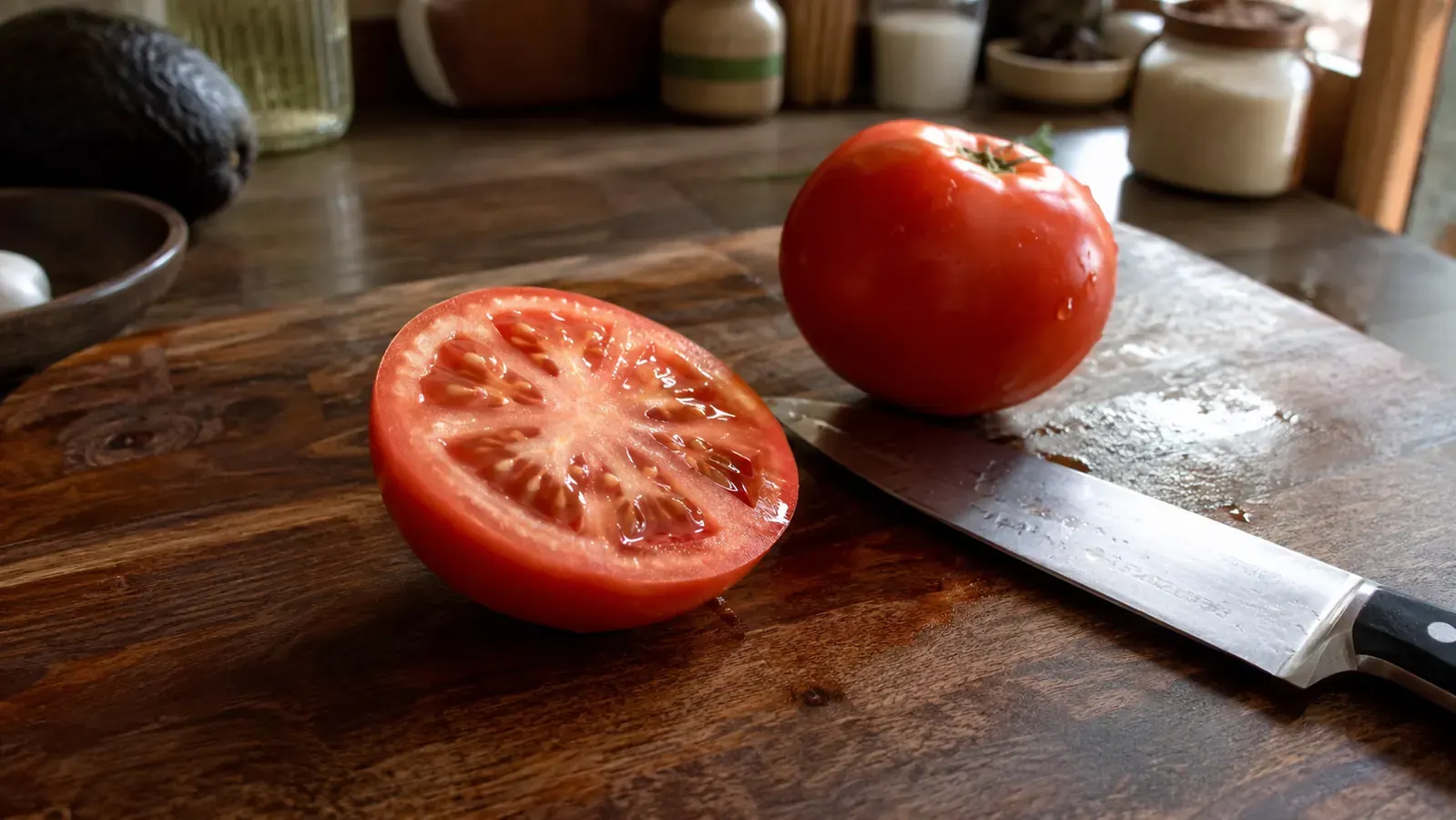
If your standard is a professional-grade mirror edge every single time, this isn't that. If your standard is a knife that reliably cuts a tomato without you leaning your whole body weight into it, the Presto clears that bar easily, and has for a full year without a single repeat trip anywhere.
What a Year of Metal Removal Actually Costs You
Every sharpening removes a small amount of metal from a blade, that's true of any method, but electric guided systems tend to take off more per pass than a whetstone because the abrasive wheels are doing the work instead of your hand controlling exactly how much pressure to apply. Over a year of running my main chef's knife through the coarse slot maybe eight times, I can see the blade has thinned slightly along the edge compared to photos I took the week it was new.
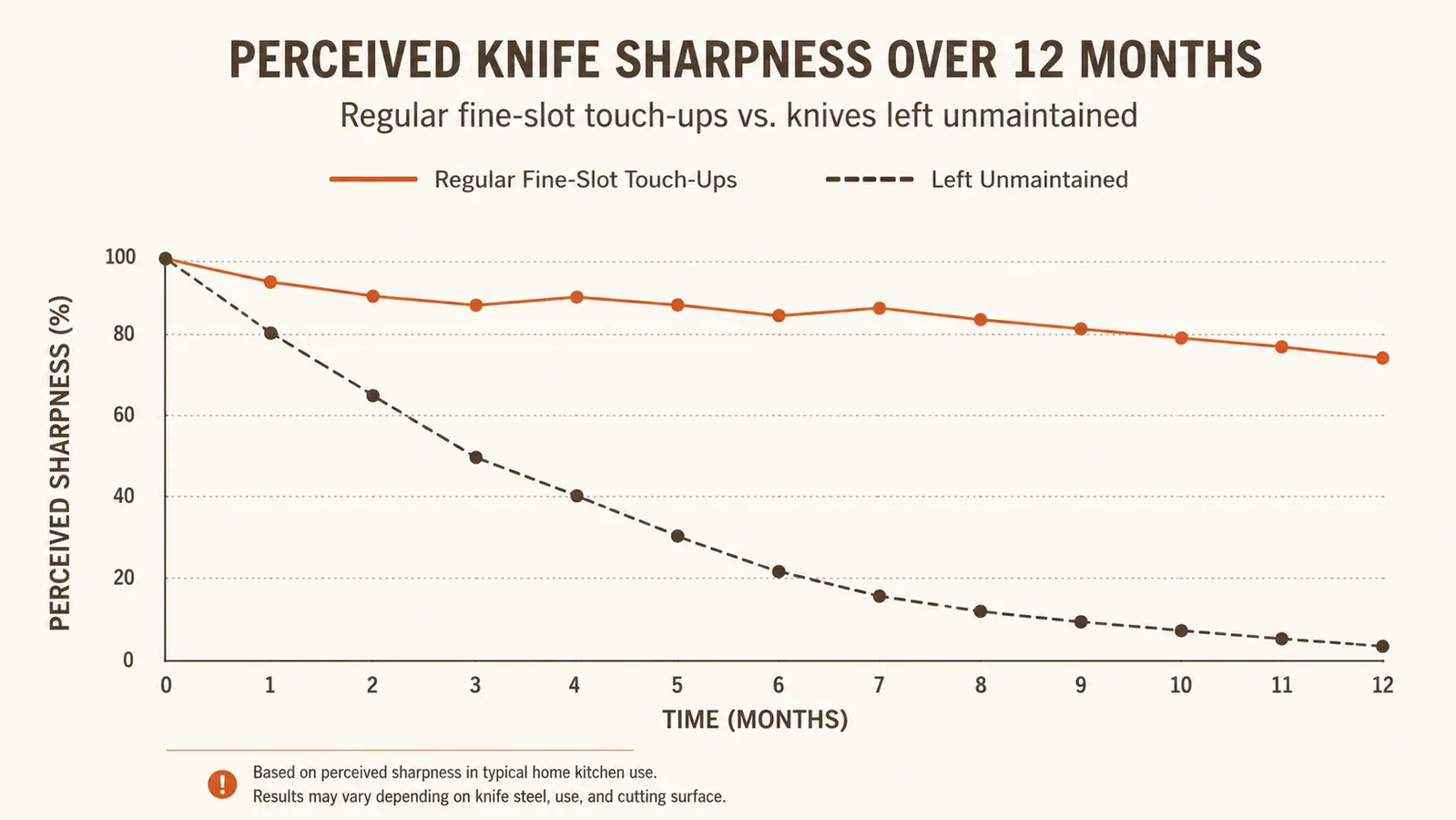
This isn't damage, it's just what sharpening is, but it did make me more selective about when I reach for the coarse slot versus the fine one. If the knife is still cutting reasonably well and just needs a touch-up, I go straight to fine and skip coarse entirely. That's a habit the manual doesn't really walk you through, it treats both slots as a standard two-step process every time, and after a year I think that's more aggressive than most knives actually need on a weekly basis.
I did the math loosely at one point, comparing how thin my chef's knife blade felt after a year against how thin it looked in a photo from the week I unboxed it. It's not dramatic, nothing close to needing replacement, but it's enough that I've started treating the coarse slot the way I treat a nail file, useful when genuinely needed, wasteful when reached for out of habit.
My advice, and this is the kind of thing you only learn by using something for twelve months instead of two weeks, is to use the coarse slot sparingly, maybe once every couple of months per knife, and lean on the fine slot for regular upkeep. The Presto EverSharp will still be there for the heavier repair work whenever a blade genuinely needs it.
The Knives It Struggles With
Thin fillet and boning knives don't sit fully flat in either guide, the curve near the tip lifts the blade just enough that you end up sharpening most of the edge well and leaving the last inch near the tip barely touched. I found this out with a boning knife I keep for breaking down chicken thighs, and I've since gone back to a small handheld stone for that one specific knife.
Knives with a full bolster near the handle, the thick metal collar some chef's knives have where the blade meets the handle, also give the housing trouble. The bolster catches against the plastic casing before the heel of the blade fully reaches the guide, so that last inch or so near the handle rarely gets a clean pass no matter how I angle it.
I also tried it once on a cheap serrated steak knife, out of curiosity more than expectation. The flat-ground area between the teeth came out a little cleaner, but the serrations themselves obviously weren't touched, which is exactly what you'd expect from a straight-edge guide system. If a serrated blade is your main daily knife, don't count on this to be the whole solution.
For everything else, standard chef's knives without a heavy bolster, utility knives, most paring knives, it does the job it says it will. That covers most of what's actually in my drawer, which is probably true of most kitchens, but if your set leans toward specialty shapes, don't expect this to be a one-tool solution.
What I Liked
- Cuts sharpening time down to a few minutes, no skill or steady hand required
- Fine slot alone is enough for regular touch-ups between full sharpenings
- Held up fine to weekly use across a full year without the motor slowing or the housing cracking
- Works well on standard western knife shapes without a heavy bolster
Where It Falls Short
- Louder than expected, not something to run during a phone call or after a sleeping baby goes down
- Coarse slot removes more metal than most knives need on a weekly basis
- Metal filings escape the housing more than the product photos suggest, plan on a paper towel underneath
- Struggles with thin fillet knives, boning knives, and anything with a full bolster near the handle
The gap between the clean product photos and the gray metal dust on my counter is the one thing I wish someone had told me before I bought this.
Who This Is For
This is for anyone who cooks most nights of the week with a standard set of western-style knives and has been getting by with dull blades because sharpening felt like too much of a production. If you want convenience over perfection and you're willing to wipe down a counter afterward, a year of daily kitchen use has made a believer out of me.
Who Should Skip It
If you own mostly Japanese-style or specialty knives with thin factory edges, or knives with a heavy bolster near the handle, or you already have the patience for a whetstone and want the sharpest possible edge every time, skip this one. It's also not for anyone in a small apartment kitchen where noise really matters, since this isn't a quiet appliance no matter how carefully you use it.
A Year In, and It's Still Doing the Job
If dull knives are slowing down your weeknight cooking, check today's price on the Presto EverSharp on Amazon.
Amazon Check Today's Price on Amazon →